House → Field
Getting Internet to Your Field
Pump controls, irrigation, gate openers, livestock cameras — Wi-Fi and network where there's no building.
Putting internet in a field is different from every other scenario: there's nowhere to mount gear, no power, and no shelter. Solve the mounting problem first — a single pressure-treated 4x4 post with a cross-arm, a mast bolted to a fence corner, or a solar-powered pole-mount enclosure.
Once you have something to mount gear on, the rest is a standard point-to-point install: one radio at the house pointing at the field, one radio on the pole. If the field needs Wi-Fi (for livestock tags, a tablet, or a remote irrigation controller), add an outdoor AP. If it needs 24V power for a pump or valve, add a PoE-injection setup at the pole.
If the field is too far for practical PtP (over ~2 miles), or line of sight is blocked, cellular becomes the right answer. An LTE gateway (Cradlepoint, Peplink, or Teltonika) with a decent antenna can get 50+ Mbps in most pastureland.
What you'll typically use it for
- Irrigation and pivot control
- Livestock GPS/RFID tag readers
- Remote livestock cameras (calving, foaling pastures)
- Automated gate openers
- Weather stations and soil sensors
What to think about
- Solve the mounting problem first — no field gear works without a solid post or mast
- Solar is often cleaner than trenching power a long way
- Consider cellular for fields over 2 miles from the house or with obstructed line of sight
- Use outdoor-rated Cat6 even between gear mounted inches apart — UV will destroy indoor cable
Best solutions for this scenario
Ranked by typical best-fit for this kind of building and distance.
- 1Point-to-Point Wireless BridgeA pair of directional radios, one on each building. The default answer for distances where running a cable is impractical.
- 2Outdoor Wi-Fi Access PointWeatherproof access points for coverage outside a building — pastures, driveways, pool decks.
- 3Cellular / LTE GatewayWhen nothing else will reach, bring its own connection. Great for very remote cabins or as failover.
Gear commonly recommended here
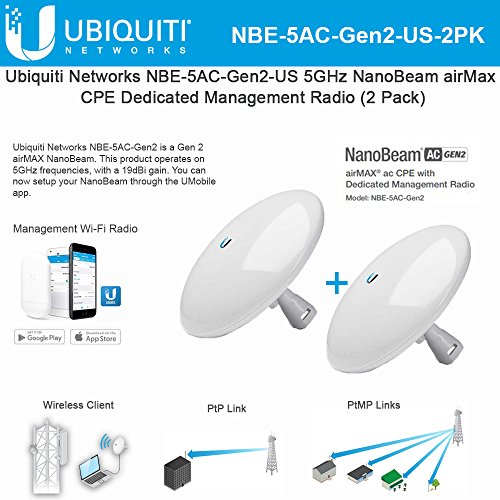
Ubiquiti NanoBeam 5AC Gen2 (NBE-5AC-Gen2), 2-Pack
Step up when you need more reach or cleaner signal.
Dish-style airMAX radio with 19 dBi gain and a dedicated management radio. Noticeably better throughput and stability than the Loco at longer distances or in noisy RF environments. Same configuration workflow as the NanoStation.
Best for: Runs from 500 ft to ~3 miles, or anywhere with heavy Wi-Fi interference.
- Higher gain = more margin for rain/foliage
- Dedicated management radio
- Gigabit PoE port
- More expensive per pair
- Narrower beam — aiming matters more
- Band
- 5 GHz
- Gain
- 19 dBi
- Range
- Up to ~15 km
- PoE
- 24V passive (included)
TP-Link Omada EAP610-Outdoor Wi-Fi 6 AP
Weatherproof AP for outdoor barn / pasture Wi-Fi.
IP68-rated outdoor Wi-Fi 6 AP. Use this if you need coverage in and around the barn — paddock, riding ring, driveway. Omada controller (cloud or self-hosted) or standalone. Works fine alongside UniFi gear on the network, just managed separately.
Best for: Outdoor Wi-Fi coverage outside the destination building.
- IP68 outdoor rated
- Wi-Fi 6 AX1800
- PoE powered
- Managed separately from UniFi gear
- PoE injector usually separate
- Wi-Fi
- Wi-Fi 6 (AX1800)
- PoE
- 802.3at
- Rating
- IP68

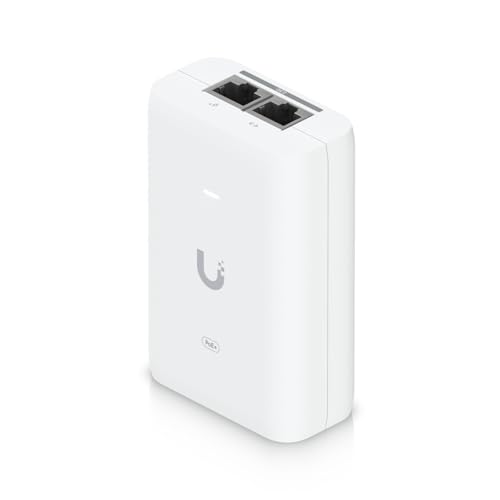
Ubiquiti PoE+ Adapter 30 W (UACC-POE+-2.5G)
Default UniFi PoE+ injector. 2.5 GbE, 30 W, Wi-Fi 6-ready.
Single-port 802.3at PoE+ injector. 2.5 Gbps data rate matches newer UniFi APs. Use it to power a U6 Lite/Pro, a camera, or an outdoor AP when you don't have a PoE switch.
Best for: Powering a single UniFi AP or camera where no PoE switch exists.
- 2.5 Gbps data rate
- 802.3at standard PoE+
- Compact
- Separate wall-wart (not in the box)
- Standard
- 802.3at
- Power
- 30 W
- Data
- 2.5 GbE