House → Cabin
Getting Internet From Your House to a Cabin
When the cabin's too far for cable but you want more than your phone's hotspot — long-range point-to-point or cellular.
The 'cabin' scenario splits into two cases. Case 1: you own both the main house and a cabin on a shared property (back-40 hunting cabin, guest cabin, seasonal retreat). Case 2: the cabin is its own property with no main-house internet to share.
For case 1, if distances are under 3 miles and you have clear line of sight, long-range point-to-point (Ubiquiti PowerBeam or NanoBeam) delivers real internet. For longer or obstructed links, buried fiber is expensive but permanent.
For case 2, cellular is almost always the answer. A fixed-wireless LTE/5G gateway (T-Mobile Home Internet, Verizon Business, or a dedicated Cradlepoint/Peplink with an external antenna) gets surprisingly good performance even in rural areas. Starlink is the fallback for truly remote cabins.
What you'll typically use it for
- Guest cabin on shared property
- Hunting or fishing cabin
- Seasonal retreat or vacation home
- Remote work-cabin
What to think about
- Know your distance first — under 3 miles with LoS = PtP; otherwise plan for cellular or Starlink
- If cabin is seasonal, consider whether the connection needs to stay up all winter (frozen electronics!)
- Cabins in ravines or valleys may have zero cellular — check before committing
- Solar + LTE gateway is a common pattern for truly remote cabins
Best solutions for this scenario
Ranked by typical best-fit for this kind of building and distance.
- 1Point-to-Point Wireless BridgeA pair of directional radios, one on each building. The default answer for distances where running a cable is impractical.
- 2Cellular / LTE GatewayWhen nothing else will reach, bring its own connection. Great for very remote cabins or as failover.
- 3Direct-Burial FiberFor long runs (over 300 ft) and future-proofing. More work to terminate, but no distance limit to speak of.
Gear commonly recommended here
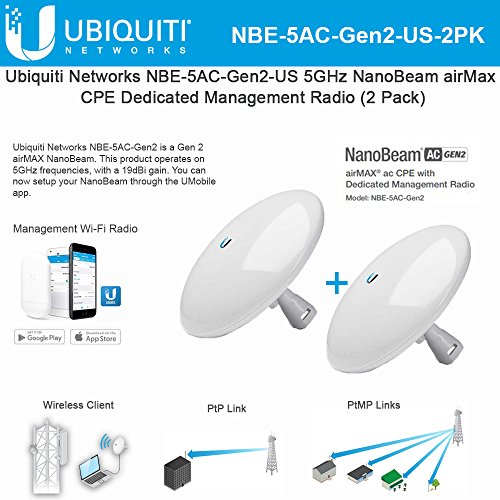
Ubiquiti NanoBeam 5AC Gen2 (NBE-5AC-Gen2), 2-Pack
Step up when you need more reach or cleaner signal.
Dish-style airMAX radio with 19 dBi gain and a dedicated management radio. Noticeably better throughput and stability than the Loco at longer distances or in noisy RF environments. Same configuration workflow as the NanoStation.
Best for: Runs from 500 ft to ~3 miles, or anywhere with heavy Wi-Fi interference.
- Higher gain = more margin for rain/foliage
- Dedicated management radio
- Gigabit PoE port
- More expensive per pair
- Narrower beam — aiming matters more
- Band
- 5 GHz
- Gain
- 19 dBi
- Range
- Up to ~15 km
- PoE
- 24V passive (included)
TP-Link Omada EAP610-Outdoor Wi-Fi 6 AP
Weatherproof AP for outdoor barn / pasture Wi-Fi.
IP68-rated outdoor Wi-Fi 6 AP. Use this if you need coverage in and around the barn — paddock, riding ring, driveway. Omada controller (cloud or self-hosted) or standalone. Works fine alongside UniFi gear on the network, just managed separately.
Best for: Outdoor Wi-Fi coverage outside the destination building.
- IP68 outdoor rated
- Wi-Fi 6 AX1800
- PoE powered
- Managed separately from UniFi gear
- PoE injector usually separate
- Wi-Fi
- Wi-Fi 6 (AX1800)
- PoE
- 802.3at
- Rating
- IP68

Ubiquiti UniFi 6 Lite Access Point (U6-Lite)
Default UniFi AP for inside the barn.
Standard 802.3af PoE Wi-Fi 6 access point. Once your bridge brings ethernet into the barn, plug this into a PoE switch or injector and you have fast Wi-Fi over the whole building. Manage via any UniFi controller (Cloud Gateway, UDR, Self-Hosted).
Best for: Indoor Wi-Fi coverage in the destination building.
- Wi-Fi 6
- Standard 802.3af PoE
- UniFi controller (free) for config
- Not outdoor-rated
- PoE injector sold separately
- Wi-Fi
- Wi-Fi 6 (AX)
- PoE
- 802.3af
- Ports
- 1x GbE
