House → Another Building
Getting Internet From Your House to Another Building
Decision framework for connecting any two buildings — indoors, outdoors, same property or across a road.
When you're not sure what kind of building you're dealing with — it's not quite a barn, not quite a shed, not quite an ADU — the decision framework is the same: distance, obstacles, and what's already in the ground.
Start with distance. Under 300 ft? Ethernet in conduit if you can, MoCA over existing coax if you have it, point-to-point otherwise. 300–1500 ft? Point-to-point is the default. Over 1500 ft? Buried fiber or long-range point-to-point with dish antennas (NanoBeam, PowerBeam).
Then check obstacles: trees, silos, other buildings, hills. Any of those between the two mounting points and point-to-point is harder (or impossible). Finally check what's already there: conduit, coax, or fiber already run between the buildings is gold — use it.
What you'll typically use it for
- Connecting any two buildings on the same property
- Cross-road or cross-driveway links
- Secondary structures with unclear use (may become an office, may stay storage)
What to think about
- Always start with a distance measurement — Google Maps satellite view works for a rough estimate
- Walk both mounting points and visually confirm line of sight before buying PtP gear
- Check for existing conduit or coax first — you may already have the solution in the ground
- For commercial buildings, see our building-to-building scenario for different regulatory considerations
Best solutions for this scenario
Ranked by typical best-fit for this kind of building and distance.
- 1Point-to-Point Wireless BridgeA pair of directional radios, one on each building. The default answer for distances where running a cable is impractical.
- 2Direct-Burial FiberFor long runs (over 300 ft) and future-proofing. More work to terminate, but no distance limit to speak of.
- 3Direct-Burial EthernetRun outdoor-rated Cat6 in conduit. Simple, rock solid, limited to 328 ft (100 m) without a switch.
Gear commonly recommended here
Ubiquiti NanoStation 5AC Loco (NS-5ACL), 2-Pack
The default UniFi point-to-point pick. One box, both ends.
The most-installed outdoor PtP radio in the world. Two of them create a dedicated wireless bridge between buildings. Small, weatherproof, 24V passive PoE. Real-world throughput ~300–450 Mbps with clear line of sight. The 2-pack ships with both ends, mounts, and injectors.
Best for: Most house-to-barn / house-to-shop installs under 1500 ft.
- Proven, huge install base, tons of community support
- airMAX config is well-documented
- Both units + mounts + PoE injectors in one box
- Requires clear line of sight
- 24V passive PoE (not 802.3af)
- Band
- 5 GHz
- Gain
- 13 dBi
- Range
- Up to 1.5 km
- PoE
- 24V passive (included)

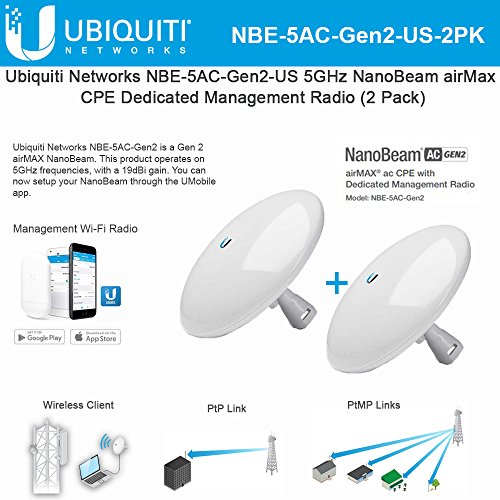
Ubiquiti NanoBeam 5AC Gen2 (NBE-5AC-Gen2), 2-Pack
Step up when you need more reach or cleaner signal.
Dish-style airMAX radio with 19 dBi gain and a dedicated management radio. Noticeably better throughput and stability than the Loco at longer distances or in noisy RF environments. Same configuration workflow as the NanoStation.
Best for: Runs from 500 ft to ~3 miles, or anywhere with heavy Wi-Fi interference.
- Higher gain = more margin for rain/foliage
- Dedicated management radio
- Gigabit PoE port
- More expensive per pair
- Narrower beam — aiming matters more
- Band
- 5 GHz
- Gain
- 19 dBi
- Range
- Up to ~15 km
- PoE
- 24V passive (included)
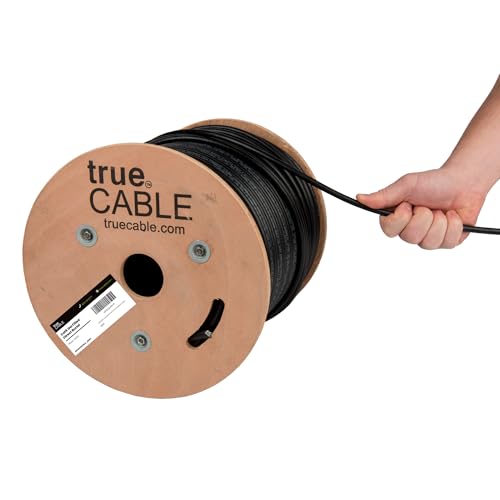
trueCABLE Cat6 Direct-Burial Bulk Ethernet, Gel-Filled, 500 ft
UV-resistant, gel-filled ethernet for outdoor runs and underground conduit.
Use outdoor-rated cable for anything that leaves the house — even if it's only running up the wall to a radio on the eaves. Gel-filled / direct-burial rating is required for unprotected underground runs. 500 ft spool is the right size for most home installs.
Best for: Any cable run exposed to sun, weather, or underground conduit.
- UV + moisture resistant
- Gel-filled for direct burial
- 23 AWG solid copper
- PoE++ rated
- Stiffer than indoor cable
- Terminations take practice
- Rating
- Cat6 Direct Burial
- Length
- 500 ft
- AWG
- 23 solid bare copper