House → ADU
Getting Internet From Your House to Your ADU
Accessory dwelling units need real, reliable internet — not a flaky Wi-Fi extender. Do it right.
An ADU (accessory dwelling unit) is a full-time living space — somebody is working from home there, streaming movies at night, and using it like any other apartment. Your internet has to be just as reliable and fast as what the main house gets, because it will be used the same way.
Compared to a barn or shed, ADUs have an advantage: they're usually closer to the main house (under 150 ft), often built with standard residential wiring, and permitted — meaning there's usually conduit between the buildings for electrical that can carry ethernet too. If that's your situation, buried ethernet or fiber is the right answer and will last 30+ years.
If there's no conduit and trenching isn't practical, a point-to-point bridge works fine. Just pick the right tier — UniFi LiteBeam or NanoStation 2-pack both deliver gigabit throughput and will outlast the tenant.
What you'll typically use it for
- Full-time rental or family occupancy
- Work-from-home with video calls
- Streaming TV services
- Smart home devices (thermostat, cameras, locks)
- Separate guest Wi-Fi network
What to think about
- Give the ADU its own SSID/VLAN for tenant privacy and security
- Throughput matters here — pick MoCA 2.5 or point-to-point 5 GHz, not powerline or mesh
- Plan for a proper router/firewall if the ADU is rented (tenant isolation)
- Bury ethernet in the same trench as the electrical if you're still building
Best solutions for this scenario
Ranked by typical best-fit for this kind of building and distance.
- 1Direct-Burial EthernetRun outdoor-rated Cat6 in conduit. Simple, rock solid, limited to 328 ft (100 m) without a switch.
- 2MoCA Over Existing CoaxIf a coax cable already runs between the two buildings, a pair of MoCA adapters gives you gigabit+ ethernet over it.
- 3Point-to-Point Wireless BridgeA pair of directional radios, one on each building. The default answer for distances where running a cable is impractical.
Gear commonly recommended here
Actiontec ScreenBeam Bonded MoCA 2.5 Adapter, 2-Pack (ECB7250K02)
Turn existing coax into a 2.5 Gbps ethernet backbone.
If your house and outbuilding are already connected by a run of coax (old TV cable, satellite, etc.), a pair of MoCA 2.5 adapters gives you up to 2.5 Gbps between them with zero digging. The ECB7250K02 ships as a starter kit with both ends in the box.
Best for: Properties with existing coax between buildings.
- No line-of-sight needed
- No digging
- Near-2.5 Gbps throughput
- Both ends included
- Requires existing coax
- Signal quality depends on cable/splitter condition
- Standard
- MoCA 2.5 (bonded)
- Throughput
- Up to 2.5 Gbps
- Ports
- 1x 2.5 GbE

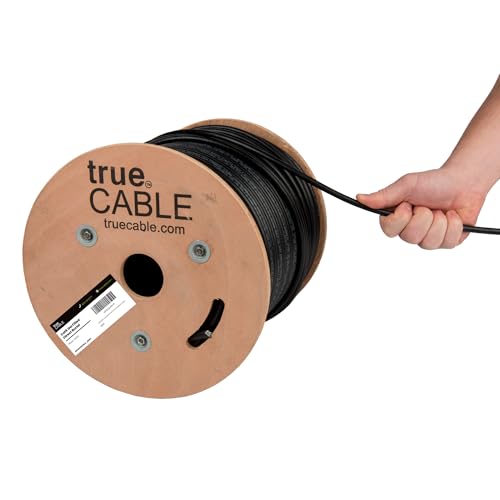
trueCABLE Cat6 Direct-Burial Bulk Ethernet, Gel-Filled, 500 ft
UV-resistant, gel-filled ethernet for outdoor runs and underground conduit.
Use outdoor-rated cable for anything that leaves the house — even if it's only running up the wall to a radio on the eaves. Gel-filled / direct-burial rating is required for unprotected underground runs. 500 ft spool is the right size for most home installs.
Best for: Any cable run exposed to sun, weather, or underground conduit.
- UV + moisture resistant
- Gel-filled for direct burial
- 23 AWG solid copper
- PoE++ rated
- Stiffer than indoor cable
- Terminations take practice
- Rating
- Cat6 Direct Burial
- Length
- 500 ft
- AWG
- 23 solid bare copper
Ubiquiti UniFi Cloud Gateway Ultra (UCG-Ultra)
The default UniFi router. Small, silent, runs the whole network.
Full UniFi OS router: firewall, VLANs, VPN, IDS/IPS, and a built-in UniFi Network controller that adopts all your UniFi APs, switches, and PtP radios. 2.5 Gbps WAN, gigabit LAN. For most home-plus-outbuilding networks this is the right brain.
Best for: Home networks with a handful of UniFi APs and switches across one or more buildings.
- Runs the UniFi controller locally — no separate device needed
- Fanless, silent
- Full IDS/IPS and VPN
- No built-in Wi-Fi (pair with a U6 Lite)
- No PoE output
- WAN
- 1x 2.5 GbE
- LAN
- 4x 1 GbE
- Throughput
- ~10 Gbps routing
